


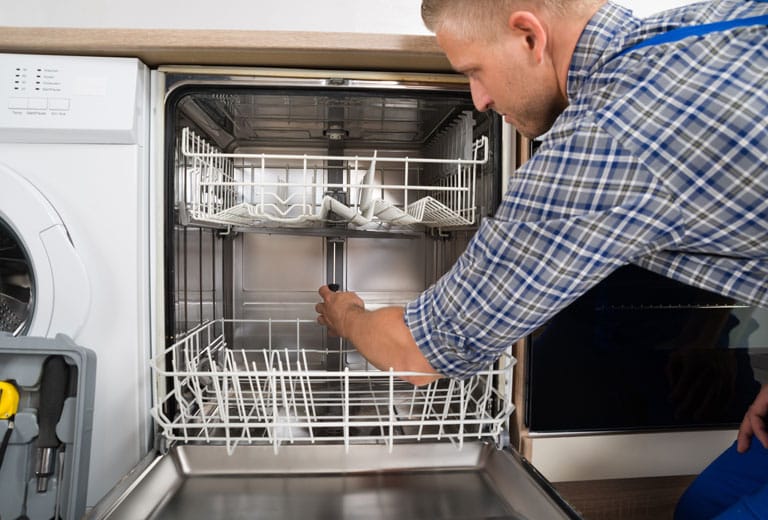
Knowing how to clean a dishwasher properly comes down to four parts most people never touch: the filter at the bottom of the tub, the spray arms, the rubber door gasket, and the drain. Food and grease collect in those places, the machine loses water pressure, dishes come out gritty, and the smell follows. In San Antonio and Austin the hard water adds a fifth job, because limescale closes the spray arm nozzles a little more with every load. The routine below takes about 45 minutes once a month. It clears the smell, restores the cleaning, and heads off the two failures that follow a neglected filter: a burnt-out drain pump and a circulation pump strangled by debris.
Key Takeaways
- A dishwasher that smells or leaves grit is almost always dirty in the four places you cannot see from the door: filter, spray arms, gasket, and drain.
- Clean the filter every one to four months, run vinegar and baking soda in separate hot cycles, and never pour vinegar into the detergent dispenser.
- Scrape plates instead of rinsing them, run full loads, and keep the water heater at 120 to 125 degrees with the booster on.
- If the smell or the standing water comes back within a week of a full clean, the drain pump, air gap, or circulation pump has a problem that cleaning will not fix.
On This Page
- What needs cleaning inside a dishwasher
- How to deep clean a dishwasher in 45 minutes
- Dishwasher maintenance habits that prevent breakdowns
- When cleaning is not the fix
- Frequently asked questions
- What to do next with a dishwasher that smells

What needs cleaning inside a dishwasher
A dishwasher recirculates a few gallons of water through a filter and out the spray arms. Anything the filter catches stays in the machine until you remove it. Anything that gets past it ends up in the arms, the pump, or the drain.
| Part | Where it is | What goes wrong when it is dirty | How often |
| Filter | Bottom of the tub, under the lower rack, twists out | Water recirculates through old food, grit on glasses, sour smell | Every 1 to 4 months |
| Spray arms | Below the lower rack and under the upper rack | Limescale blocks the nozzles, pressure drops, top rack stays dirty | Every 3 months, or when nozzles look white |
| Door gasket | Rubber seal around the tub opening and the bottom lip of the door | Mildew and black film, musty smell, eventual leak | Monthly wipe |
| Drain and air gap | Rear of the tub, and the small chrome cap by the faucet if you have one | Standing water, sewer smell, dishwasher backs up into the sink | Every 3 months |
| Detergent dispenser | Inside of the door | Caked detergent, pods that never open | Monthly wipe |
The intervals aren’t ProStar’s invention. Thermador’s own care guide tells owners to clean the filter every one to four months depending on how much starch and food soil goes through the machine, and it names limescale in the spray arm nozzles as the reason a dishwasher stops cleaning well. In South Texas water, the shorter end of that range is the right one.
How to deep clean a dishwasher in 45 minutes
Empty the dishwasher first. Most of this is waiting for cycles to finish, and the hands-on work is about fifteen minutes.
- Pull the lower rack. Twist the filter counterclockwise, lift it out, and take the flat mesh plate with it if your model has one. Scrub both with a soft brush and dish soap. Expect lemon seeds, glass chips, and a gray paste of grease and detergent.
- While the filter drains, look into the sump where it sat and scoop out anything sitting on the pump cover. Then put the filter back and turn it until it clicks. A filter that isn’t locked lets debris straight into the pump.
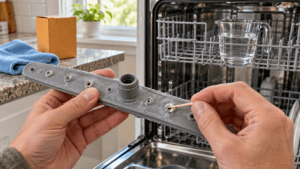
- Unclip the spray arms and hold them up to the light. Clear every blocked nozzle with a toothpick, rinse, and refit. If the nozzles are crusted white, soak the arms in a bowl of white vinegar for half an hour first.
- Wipe the door gasket, the bottom lip of the door, and the hinge area with a cloth wrung out in warm soapy water. Get into the fold of the seal, which is where the black film lives.
- Put one cup of white vinegar in a dishwasher-safe bowl on the top rack and run the hottest, longest cycle with nothing else in the machine. Do not pour vinegar into the dispenser; the acid works on the dispenser’s rubber seal.
- Once that cycle finishes, sprinkle a cup of baking soda across the floor of the tub and run a short hot cycle. Keep the two in separate cycles. Together they fizz and cancel each other out.
- Leave the door cracked overnight so the tub dries. A dishwasher that sits closed and wet grows the smell back within days.
A dishwasher cleaner tablet does the same job as the vinegar cycle and handles limescale better. Either way, the filter and the spray arms need hands. No cycle cleans them.
Dishwasher maintenance habits that prevent breakdowns
A clean dishwasher stays clean if a few habits change. None of them cost money.
- Scrape, don’t rinse. ENERGY STAR’s dishwasher guidance says pre-rinsing only adds water and energy, because modern detergents need some soil to work on. Scrape the plate, skip the sink, and the enzymes do their job instead of foaming in clean water.
- Run the kitchen tap hot before you press start. The first fill uses whatever is sitting in the pipe, and a cold first fill means a weak main wash.
- Set the water heater to 120 to 125 degrees and use the dishwasher’s heat boost. The Department of Energy’s dishwasher guidance puts it plainly: dishwashers want 135 to 140 degree water, the built-in booster adds 15 to 20 degrees, and a 120 to 125 degree heater setting gets you there without scalding risk at the sink.
- Fill the rinse aid dispenser. In hard water it is not optional. It is the difference between clear glasses and a white film that eventually coats the heating element.
- Run the garbage disposal with plenty of water before the vinegar cycle. The dishwasher drains through it, and a full disposal is a slow dishwasher drain.
When cleaning is not the fix
A full clean should leave you with a dishwasher that drains, smells like nothing, and puts out clear glasses. Three results mean something has failed, and more cleaning won’t change them.
The smell is back within a week, or there is standing water
Sewer smell after a clean is usually the drain path, not the tub. The drain hose needs a high loop under the sink or an air gap on the counter so sink water cannot run back into the dishwasher. A new disposal with the knockout plug left in, a sagging hose, or a drain pump that no longer empties the sump will all bring the smell and the puddle straight back. The pump is the one that costs money, and it fails from years of debris getting past an unlocked filter.
Dishes still come out dirty with clean arms and a clean filter
If the arms spin freely by hand and the nozzles are clear, weak washing points at the circulation pump, the water inlet valve, or a heating element that no longer brings the wash water up to temperature. Glasses that come out wet and filmed on a heated-dry cycle usually mean the element. None of these are homeowner parts. That is the job ProStar’s residential dishwasher repair covers, and the technician will show you the failed part before quoting.
The machine hums, trips a breaker, or leaks from under the door
A hum with no water movement is a seized pump. A breaker trip is electrical and means stop using the machine. Water from under the door is a gasket or latch; water from under the machine is a hose or a pump seal. Turn it off at the breaker and shut the supply valve under the sink until it has been looked at. The tub, filter, arms, and gasket are yours to clean. The pumps, valve, element, and control board are not.
ProStar’s San Antonio location on W Rhapsody Drive covers Alamo Heights and Stone Oak out to Boerne and New Braunfels, and the Round Rock location serves the greater Austin area. Repairs use original manufacturer parts and carry a 90-day warranty on parts and labor, and that includes the Bosch, Miele, and Thermador machines whose three-piece filters are easy to reassemble wrong.
Restaurants and hotel kitchens are a different conversation. A Hobart or Jackson door-type machine runs dozens of racks a day, and its filters, scrap trays and wash arms need attention every shift rather than every month. ProStar handles commercial dishwasher repair across both metros. Austin operators can book commercial dishwasher service in Austin through the same number.
Frequently asked questions
What is the best thing to clean a dishwasher with?
Clean a dishwasher by hand first and by cycle second. Scrub the filter and spray arms with dish soap and a brush, wipe the gasket, then run one hot cycle with a cup of white vinegar on the top rack and a short hot cycle with baking soda on the tub floor. A cleaner tablet can replace the vinegar cycle.
Can I pour vinegar in my dishwasher to clean it?
Yes, but put the vinegar in an open bowl on the top rack, not in the detergent dispenser and not on the tub floor. In the dispenser it attacks a rubber seal; on the floor most of it drains away before the wash starts. Use one cup, run the hottest cycle empty, and keep baking soda for a separate cycle.
How often should you clean a dishwasher?
Clean the filter every one to four months, wipe the gasket monthly, and run a vinegar or cleaner cycle once a month. Check the spray arm nozzles every three months, sooner in hard water areas like San Antonio and Austin where limescale closes them faster. A household that runs the dishwasher daily should use the short end of each interval.
Why does my dishwasher smell even after cleaning it?
A dishwasher that still smells after a full clean is usually pulling the smell from the drain, not the tub. A drain hose with no high loop or air gap lets sink water flow back in, a disposal knockout plug left in blocks drainage, and a weak drain pump leaves water in the sump between cycles. Those need a technician.
What to do next with a dishwasher that smells
Pull the filter and look at it. If it is packed, the 45-minute routine above fixes the smell and the grit, and the habits keep it fixed. If the filter is clean and the smell or the standing water is still there, something in the drain path or the pump has failed.
ProStar technicians take dishwasher calls across San Antonio and the Austin area from 6 AM to 10 PM, every day. Book a dishwasher technician online. If you’d rather talk to someone first, call (210) 941-4634.

