


If your dishes come out of the dishwasher with a cloudy white film, your washing machine sounds different than it used to, or your water heater seems to be working harder for less hot water, hard water is probably behind it. Most Texas homeowners notice these symptoms and assume the appliance is getting old. That’s rarely the real cause.
Texas has some of the hardest water in the country, and the mineral buildup that accumulates inside your appliances over months and years does real, measurable damage. It reduces efficiency, drives up energy bills, shortens appliance lifespans, and eventually forces expensive repairs or full replacements that could have been avoided.
What Hard Water Actually Is and Why Texas Has So Much of It
Hard water simply means water with a high concentration of dissolved minerals, primarily calcium and magnesium. The hardness comes from the geology the water passes through before it reaches your tap.
Texas sits on massive limestone formations. Austin’s water hardness, at 184 parts per million, is caused by limestone formations in the Edwards Aquifer, leading to mineral buildup in plumbing systems. San Antonio has it even worse. San Antonio water registers at 357 parts per million due to the Edwards Aquifer, meaning residents have elevated levels of limestone in their water. For reference, water over 60 parts per million is considered moderately hard. Both cities sit well beyond that threshold, with San Antonio nearly six times above it. Roto-RooterReliant Plumbing
Texas is known for having some of the hardest water in the country. Cities like San Antonio, Austin, and Dallas experience high mineral content in their water supplies, mainly due to the natural composition of the rocks and soil in the region, which causes calcium and magnesium to dissolve into the water. Lonestarwaterservice
The minerals themselves aren’t a health problem. But what they do inside your appliances over time is.
How Mineral Buildup Actually Damages Appliances
When hard water sits in a pipe, tank, or heating element, the minerals don’t stay dissolved. Heat, evaporation, and pressure changes cause calcium and magnesium to precipitate out of the water and deposit onto whatever surface they’re in contact with. That deposit is called limescale, and it builds up gradually in layers.
The damage is slow enough that most people don’t notice it happening. By the time an appliance starts showing obvious symptoms, months or years of buildup have already accumulated on the internal components.
Here’s what that looks like in practical terms:
- A thin layer of scale on a heating element forces it to work harder to reach the same temperature
- Restricted water flow through mineral-coated pipes and spray arms means reduced performance
- Sensors and valves coated in mineral deposits give inaccurate readings or fail to operate correctly
- Seals and gaskets exposed to hard water can degrade faster than normal
Appliance wear is a direct result of hard water. Dishwashers, washing machines, and water heaters lose efficiency as scale coats internal parts, driving up energy bills. AquaTech of Idaho
The energy cost alone is worth paying attention to. A water heater working against significant limescale buildup can use noticeably more energy to deliver the same amount of hot water, and that shows up on your utility bill every month.
Which Appliances Take the Most Damage From Texas Hard Water
What Hard Water Does to Your Dishwasher
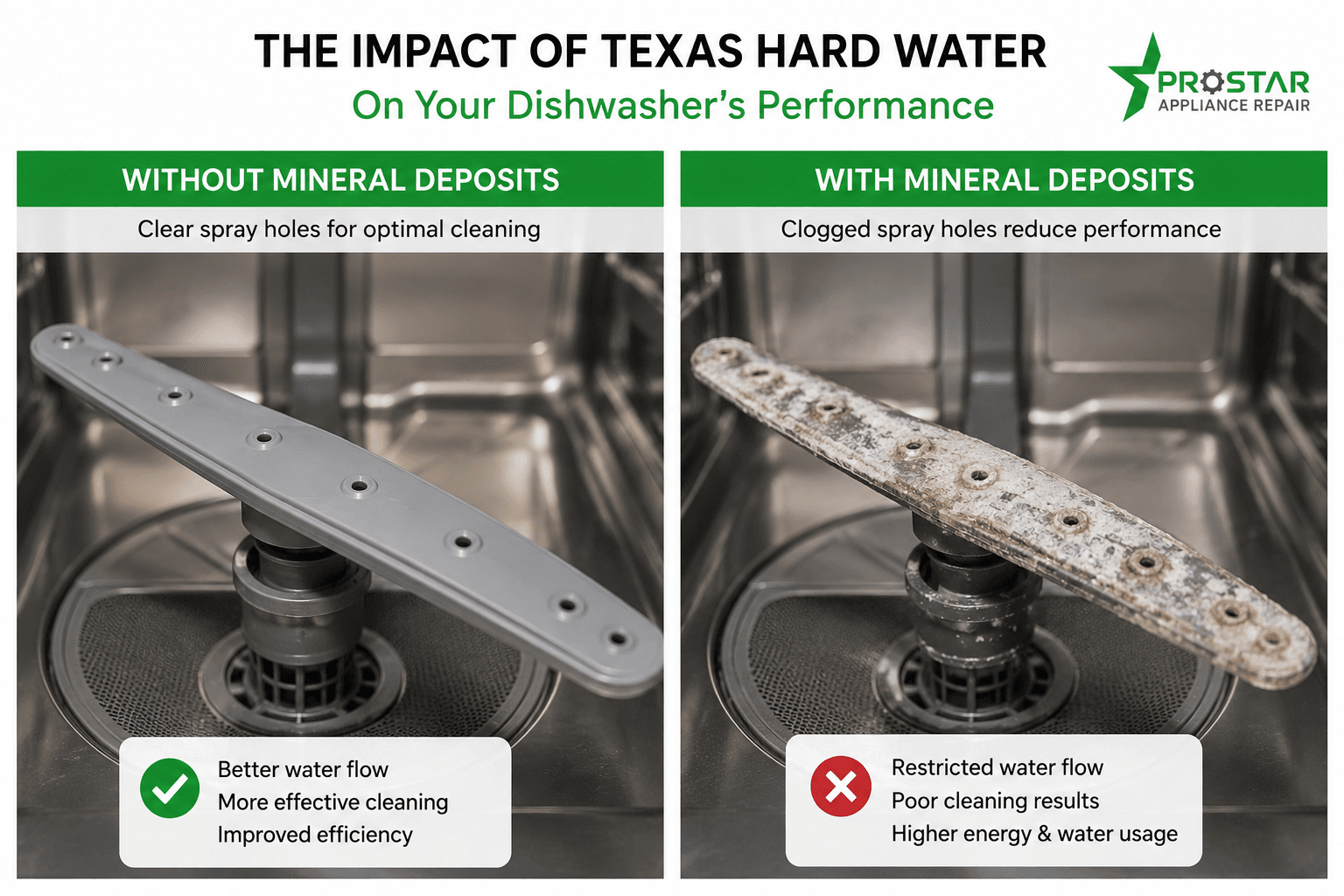
The dishwasher is usually the first place Texas homeowners notice a hard water problem, because the evidence is visible. White spots and streaks on glasses, cloudiness on dishes, and residue on the interior walls of the machine are all signs that mineral deposits are accumulating.
But the cosmetic issues are the least of it. Hard water affects dishwashers by leaving white spots and streaks on dishes, glassware, and utensils due to the minerals in the water, which dry onto surfaces instead of rinsing away. Lonestarwaterservice
What’s happening inside the machine is more serious:
- Spray arms clog with mineral deposits, reducing water pressure and cleaning coverage
- The heating element develops scale buildup that forces it to work harder and reduces its lifespan
- The internal pump and filter system work against increasing mineral resistance
- Detergent becomes less effective because hard water interferes with how cleaning agents dissolve and activate
If your dishwasher has been running in Austin or San Antonio water for a few years without any descaling maintenance, there’s a good chance the interior components are already showing the effects.
What Hard Water Does to Your Washing Machine
The washing machine is one of the most water-intensive appliances in your home. Every cycle passes hard water through the drum, hoses, pump, and heating elements, and every cycle deposits another thin layer of scale on those components.
Hard water can shorten the lifespan of washing machines by damaging internal components through mineral buildup, leading to costly repairs or early replacement. Lonestarwaterservice
The specific damage points in a washing machine include:
- The drum and drum seal, where mineral deposits accumulate and can cause friction and premature wear
- Water inlet valves, which are small and can restrict or fail as scale builds up around them
- The heating element in machines that heat water internally
- Hoses and connections, where hard water deposits can eventually contribute to leaks
You’ve probably noticed that laundry from hard water areas sometimes feels stiff or rough after drying, even with normal detergent amounts. That’s because hard water reduces how effectively detergent rinses out of fabric. Over time, this also means people use more detergent than necessary, which compounds the buildup inside the machine.
What Hard Water Does to Your Water Heater
The water heater is where Texas hard water causes the most financially significant damage, and it’s the appliance most people think about least until something goes wrong.
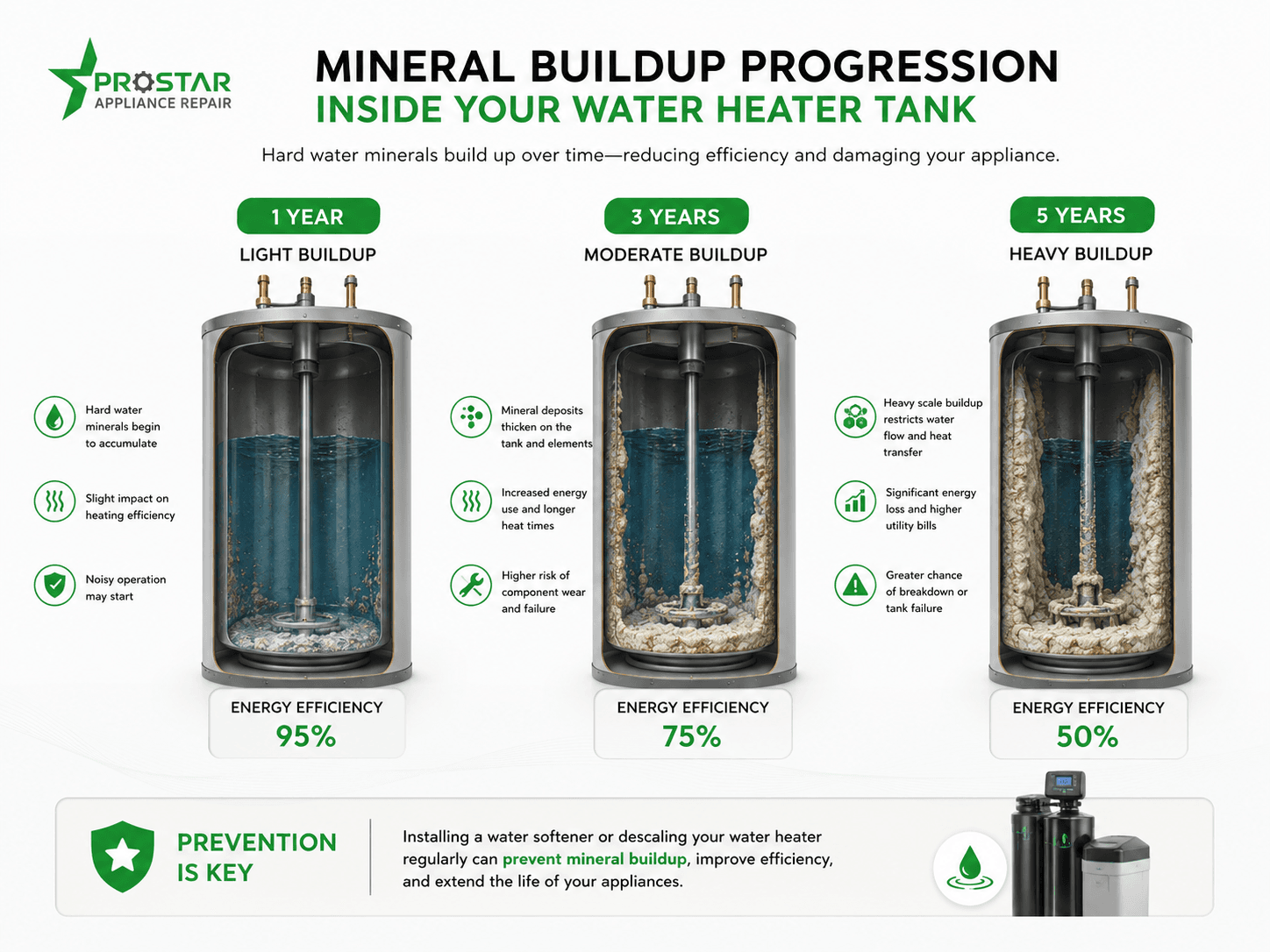
Every time your water heater heats water, the heat causes minerals to precipitate and settle at the bottom of the tank. That layer of sediment gets thicker every year. Slow heating times result from mineral deposits making it harder for the heating element to work efficiently, increasing energy costs for homeowners. Lonestarwaterservice
A water heater tank that’s accumulating significant sediment:
- Takes longer to heat water to the desired temperature
- Uses more energy per heating cycle
- Produces a rumbling or popping sound when heating, which is sediment being disturbed
- Has a shortened overall lifespan because the tank walls and components are under constant thermal and mineral stress
The interaction between limestone-enriched water and home systems leads to mineral accumulation in pipes, fixtures, and appliances. Over time, these deposits can restrict water flow, reduce appliance efficiency, and potentially lead to costly water damage.
Tankless water heaters face a different version of this problem. Because they heat water on demand through narrow heat exchanger channels, those small passages are especially vulnerable to scale blockage. Many manufacturers require annual descaling and water treatment as a condition of warranty coverage in hard water areas.
What Hard Water Does to Your Refrigerator Ice Maker and Water Dispenser
If your refrigerator has an ice maker or water dispenser, those features run on the same hard water supply as everything else in your home.
Mineral buildup in the water line that feeds the ice maker restricts flow over time, eventually reducing ice production or stopping it entirely. The dispenser nozzle can clog with scale. And in some cases, the filter inside the refrigerator has to work harder and gets replaced more frequently than it would with softer water.
Ice produced from very hard water often has a slightly off taste or a cloudy appearance rather than the clear look of properly filtered ice. If you’ve noticed this in your Austin or San Antonio home, hard water mineral content is almost certainly the reason.
How to Tell If Hard Water Is Already Affecting Your Appliances
You don’t need a water test to see the early signs. Most Texas homeowners already have visible evidence in their home if they know what to look for.
Visual signs to check right now:
- White or chalky residue around faucets, showerheads, and the inside of your dishwasher
- Cloudy glassware even after a full dishwasher cycle
- Discoloration or film on the interior walls of your washing machine drum
- A visible crust around the water inlet at the back of your washing machine
- Water pressure from your kitchen faucet has gradually decreased without any obvious cause
Performance signs that suggest mineral damage is already underway:
- Dishwasher isn’t cleaning as well as it used to even with the same detergent
- Washing machine cycles taking longer or clothes not feeling fully rinsed
- Water heater taking noticeably longer to produce hot water
- Higher utility bills without a clear change in usage habits
- Unusual sounds from the water heater during heating cycles
If several of these describe your situation, the appliances themselves may be in good mechanical condition. The performance drop is likely scale buildup, which is reversible at the maintenance stage but becomes a repair or replacement issue if left long enough.
What You Can Do to Protect Your Appliances From Hard Water Damage
Regular Descaling Maintenance
The most direct protection is regular descaling of the appliances that use water most intensively.
For dishwashers, running a cleaning cycle with a citric acid-based descaler every one to two months removes the mineral buildup from spray arms, the heating element, and the interior walls before it hardens into a thicker layer. White vinegar works as a basic alternative, though commercial descalers formulated for hard water areas are more effective on Texas-level mineral concentrations.
For washing machines, monthly cleaning cycles with a machine cleaner that specifically addresses limescale are important. Front-load machines are particularly prone to buildup in the door gasket and drum, and that buildup accelerates in hard water households.
For water heaters, flushing the tank annually removes the sediment layer that accumulates at the bottom. This is something most plumbers or appliance technicians can do as a routine maintenance visit. If it hasn’t been done on your current water heater, the amount of sediment you see when the tank is flushed may be surprising.
Using the Right Products for Hard Water Conditions
Standard detergents and cleaning products aren’t always formulated with Texas-level water hardness in mind. Using a detergent with built-in water softening agents, or adding a separate rinse aid to your dishwasher, makes a meaningful difference in how effectively hard water minerals are managed during cycles.
For washing machines, using a slightly higher detergent dose than the package minimum recommendation, combined with a periodic descaling product, helps compensate for the reduced effectiveness of detergent in hard water.
Whole-Home Water Softening
A water softener is the most comprehensive solution because it addresses hard water at the source rather than managing the symptoms appliance by appliance. Professional water treatment solutions can effectively manage these minerals, preventing scale buildup and extending the lifespan of home appliances and plumbing systems.
A properly sized water softener replaces the calcium and magnesium ions in your water supply with sodium ions through an ion exchange process. The water that reaches your appliances no longer contains the minerals that cause scale, which means descaling maintenance becomes far less frequent and appliance lifespans improve.
The upfront cost of a water softener system for an Austin or San Antonio home typically ranges from a few hundred to a few thousand dollars depending on the system capacity and installation requirements. Over the lifetime of your appliances and given the energy savings from appliances running at full efficiency, most homeowners find the investment pays for itself.
How Much Damage Are Texas Homeowners Actually Dealing With
The numbers put the issue in concrete terms.
Appliance | Normal Lifespan | Lifespan With Untreated Hard Water | Primary Damage Point |
Dishwasher | 9 to 12 years | 6 to 8 years | Spray arms, heating element, pump |
Washing Machine | 10 to 14 years | 7 to 10 years | Drum seal, inlet valves, internal hoses |
Tank Water Heater | 8 to 12 years | 6 to 8 years | Tank floor sediment, heating element |
Tankless Water Heater | 15 to 20 years | 10 to 12 years without descaling | Heat exchanger channels |
Refrigerator Ice Maker | 10 to 15 years | Variable, water line and valve issues | Water inlet valve, dispenser nozzle |
These aren’t worst-case numbers. They reflect what happens when an appliance runs in hard water conditions without proactive maintenance over its lifespan. Appliances like water heaters and washing machines may have a shorter lifespan due to mineral buildup, particularly in Texas where heavy limestone geology contributes to the natural occurrence of hard water.
When you factor in replacement costs for a water heater, washing machine, or dishwasher, the financial case for preventive maintenance and water treatment becomes straightforward.
When Hard Water Damage Has Already Happened
Prevention is the goal, but if your appliances are already showing the effects of years of hard water exposure, the situation isn’t always as simple as a descaling treatment.
Scale buildup that’s been accumulating for several years can harden to a point where it damages components when it’s removed, or where the components themselves have already degraded beyond the point where cleaning restores performance. A heating element that’s been coated in mineral deposits for years may have developed hot spots that weaken the element itself. An inlet valve that’s partially blocked by scale may fail entirely when cleaning disturbs the buildup.
That’s usually where things go wrong for homeowners who attempt aggressive DIY descaling on appliances that have gone years without maintenance. The descaling works, but reveals damage underneath that needs repair.
If your dishwasher, washing machine, or refrigerator is showing hard water-related performance problems and basic maintenance hasn’t resolved them, a professional technician can assess what’s actually going on inside the machine and whether repair makes more sense than replacement at that point.
Is Your Appliance Repairable or Does Hard Water Damage Mean Replacement
This is a question our technicians at ProStar Appliance Repair get regularly from Austin and San Antonio homeowners. The answer depends on what’s actually damaged and how far the deterioration has progressed.
Hard water damage that’s caught at the maintenance stage, cloudy dishes, slightly reduced performance, visible white residue inside the machine, is almost always fixable with cleaning and component checks. Hard water damage that’s been progressing for years without attention can mean failed heating elements, seized pumps, cracked drum seals, or corroded water lines that need replacement parts.
What we typically find when a homeowner calls about a dishwasher that suddenly stopped cleaning well, or a washing machine that’s vibrating excessively, is a combination of mineral buildup and one or two components that have failed as a direct result of that buildup over time. Replacing the specific failed components and thoroughly descaling the machine usually restores performance to near-original levels, and costs significantly less than a new appliance.
The repair versus replace calculation in these situations depends on the age of the appliance, the cost of the specific parts needed, and whether the core mechanical components are still in good shape. Our technicians provide honest guidance on that question after a proper diagnostic, not a one-size-fits-all answer.
Is Your Appliance Struggling With Hard Water Damage? We Can Help.
If you’re in Austin or San Antonio and your dishwasher, washing machine, refrigerator, or other major appliance isn’t performing the way it should, hard water damage is one of the most common causes we see.
At ProStar Appliance Repair, our certified technicians work with all major brands including Whirlpool, LG, Samsung, GE, Bosch, Frigidaire, Maytag, and KitchenAid. We offer same-day and next-day service, use only genuine replacement parts, and back every repair with a 90-day warranty on parts and labor. Whether it’s a descaling assessment, a failed component from mineral damage, or a full diagnostic to figure out what’s actually wrong, we give you a clear picture and a straight answer before any work begins.
Book your appliance repair appointment with ProStar here.
Frequently Asked Questions About Texas Hard Water and Appliances
How hard is the water in Austin and San Antonio?
Austin water registers at approximately 184 parts per million, which is classified as hard water. San Antonio’s water comes in significantly higher at around 357 parts per million, making it one of the hardest municipal water supplies in Texas. Both cities draw from the Edwards Aquifer, which passes through extensive limestone formations and picks up high concentrations of calcium and magnesium in the process.
What are the first signs that hard water is damaging my appliances?
The most visible early signs are white or chalky residue on the inside of your dishwasher, cloudy glasses after a full wash cycle, and crusty buildup around faucet openings and the water inlet on your washing machine. Performance signs include dishes not cleaning as well as they used to, laundry feeling stiff, and your water heater taking longer to produce hot water. Any of these on their own could have other causes, but several together in a Texas home almost always point to mineral buildup.
How often should I descale my dishwasher in Texas?
In Austin and San Antonio, every one to two months is a reasonable interval. The higher the hardness level in your specific area, the more frequently mineral deposits accumulate on spray arms, heating elements, and interior surfaces. Using a rinse aid in every cycle slows buildup between cleaning cycles and reduces spotting on dishes.
Can hard water damage be repaired or does it mean the appliance needs replacing?
In most cases, hard water damage that’s caught before a component has fully failed can be addressed through professional cleaning and targeted part replacement. Heating elements, inlet valves, spray arms, and pump components that have been degraded by mineral buildup are repairable or replaceable. A thorough diagnostic by a certified technician will tell you exactly what’s needed. Our team at ProStar Appliance Repair sees this regularly in Austin and San Antonio homes and can assess whether repair or replacement is the right call for your specific situation.
Does a water softener actually make a difference for appliances?
Yes, meaningfully so. A whole-home water softener removes the calcium and magnesium ions before they reach your appliances, which eliminates the source of limescale buildup entirely. Appliances in softened water homes require far less descaling maintenance, tend to perform at their rated efficiency for longer, and typically last closer to their designed lifespan. The energy savings from appliances running without mineral resistance also contribute to the return on investment over time.
Is hard water the reason my dishwasher smells bad?
It can be a contributing factor. Mineral deposits on the interior surfaces of a dishwasher create rough texture that traps food particles and detergent residue more effectively than a clean surface would. That trapped material can develop odors over time. Descaling the interior surfaces and running a hot cycle with a dishwasher cleaner usually resolves the odor issue alongside the mineral buildup. If the smell persists after cleaning, other issues like a blocked filter or drain problem may also need attention.
My washing machine clothes smell musty even after washing. Is hard water causing that?
Hard water can be part of the reason. Detergent in hard water doesn’t rinse out of fabric as cleanly as it does in soft water, and residual detergent combined with mineral deposits inside the drum can contribute to odor over time. Front-load washers are particularly prone to this because the door gasket traps moisture and can develop mold in the presence of mineral and detergent buildup. Running a monthly maintenance cycle with a washing machine cleaner designed for hard water is a straightforward fix.
How do I know if my water heater has significant sediment buildup?
A rumbling, popping, or cracking sound during the heating cycle is the most common sign, and it comes from water bubbles percolating through the sediment layer at the bottom of the tank. Longer wait times for hot water at the tap and higher gas or electric bills without a clear change in usage are also indicators. An annual tank flush as part of routine maintenance prevents the buildup from reaching the point where it affects the heating elements or tank integrity.
What appliance brands hold up better against hard water damage?
No major appliance brand is immune to hard water damage because the problem is chemical, not mechanical. What matters more than brand is maintenance frequency and whether a water softener or filtration system is in use. That said, some appliances in our dishwasher repair service and washer repair service work show that stainless steel interior components tend to resist mineral adhesion slightly better than plastic ones, which is worth considering when replacing an appliance in a hard water area.
Does ProStar Appliance Repair service hard water-related appliance issues in Austin and San Antonio?
Yes. Hard water damage is one of the most common causes behind the appliance problems we diagnose in both Austin and San Antonio. Our certified technicians are familiar with exactly how Texas mineral content affects dishwashers, washing machines, water heaters, refrigerators, and other major appliances. We offer same-day and next-day appointments, genuine replacement parts, and a 90-day warranty on all repairs. Contact our team here to book a diagnostic visit.

