


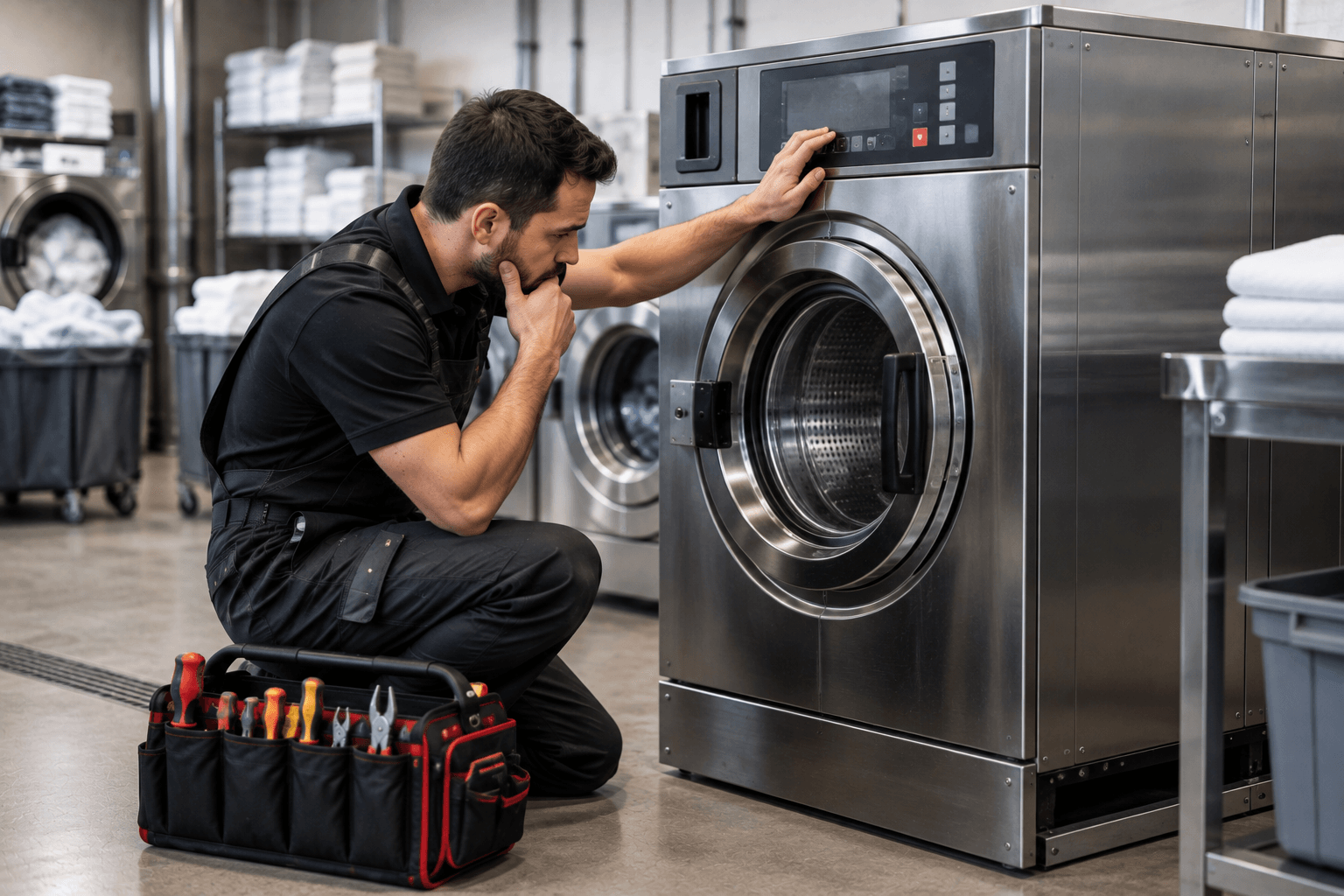
A washing machine loud noise during spin comes from one of four places in almost every case: a load that shifted to one side, a machine that isn’t sitting level, suspension parts that have worn out, or drum bearings that are failing. The first two you can fix in twenty minutes with your hands and a bubble level. The last two need a technician, and the sound tells you which one you have before anyone opens the cabinet. This guide matches each noise to its cause, walks through the checks worth doing yourself, and marks the point where a loud washer stops being a nuisance and starts being a safety problem.
Key Takeaways
- Banging and thumping during spin is usually an unbalanced or oversized load, or a washer that has walked off level. Both are homeowner fixes.
- A grinding or rumbling noise that rises with spin speed points to worn drum bearings. That is a repair, and it gets worse every load.
- On a new or recently moved front loader, violent shaking on the first spin almost always means the shipping bolts were never removed.
- Any noise that comes with a burning smell, a puddle, or a drum you can rock by hand means stop the cycle and book a technician.
On This Page
- What a noisy washer spin is telling you
- How to fix a washer banging during the spin cycle
- Washer grinding noise: bearings, seals, and Texas water
- When the noise means a repair
- Frequently asked questions
- What to do next about a loud washing machine

What a noisy washer spin is telling you
Listen before you touch anything. The kind of sound, and when in the cycle it happens, narrows the cause to one or two parts.
| Sound | When it happens | Most likely cause | Fix yourself? |
| Banging or thumping, machine rocks | As spin ramps up | Load bunched on one side, single heavy item, or washer not level | Yes |
| Violent shaking on a new or moved washer | First spin after install | Shipping bolts still in the back panel | Yes |
| Grinding or rumbling that rises with speed | Full spin, every load | Worn drum bearings, often with water past the tub seal | No |
| Squeal or high whine | Wash and spin | Drive belt slipping, or motor bearings | No |
| Rattle or buzz, worst while draining | End of cycle | Coin or button in the drain pump filter, or a loose hose | Yes |
| Heavy clunk, then the drum hops | High spin | Broken suspension rod or worn shock absorber | No |
The noises in the first, second, and fifth rows are the cheap ones. Maytag’s own troubleshooting guide puts overloading and an unlevel machine at the top of its list for thumping and vibration, and reserves grinding, scraping, and metal-on-metal sounds for the call-a-professional category. That split holds across brands.
How to fix a washer banging during the spin cycle
Work through these in order on an empty machine. If the banging stops after any step, you’re done.
- Check the drum before the load. Open the door and push the drum. It should move with a springy give. On a front loader, if it feels bolted solid, the shipping bolts on the back panel are still in. Unplug the washer and remove them with the wrench that came in the box.
- Rock the machine corner to corner. Any wobble means a leg isn’t touching the floor. Loosen the lock nut, turn the leg until all four sit firm, tighten the nut, and keep the legs as short as possible. A washer on a pedestal or carpet will always vibrate a little more.
- Size the load to about two-thirds of the drum. A single comforter, bath mat, or pair of jeans on its own will throw the drum every time. Add two or three towels to balance a bulky item, or drop the spin speed.
- Pull the drain pump filter, behind the small panel at the bottom front, and check it for coins, buttons, and hair ties. Put a towel and tray down first.
- Push the drain hose and the inlet hoses out of contact with the cabinet and the wall, and pull anything stored in a pedestal drawer that could rattle.
Two numbers worth keeping in mind. Samsung’s shaking-washer guide calls a small load 3 to 5 pounds, a large load 6 to 16 pounds, and one pair of jeans about a pound, and it asks for an inch of clearance between the washer and anything beside it. LG’s noise troubleshooting page adds that rugs, blankets, mats, and waterproof fabrics lopside the drum more than anything else, and that an empty drum you can turn by hand without noise is the quickest test that nothing is stuck inside.
Washer grinding noise: bearings, seals, and Texas water
A washer grinding noise that builds as the drum speeds up, and keeps building month after month, is the drum bearings. They sit behind the tub, sealed from the water by a rubber tub seal. When that seal wears, water reaches the bearings, the grease washes out, and the metal starts eating itself. You’ll often see a rust-colored streak on the floor under the machine, and if you grab the top of the drum and lift, it will move more than a fraction of an inch.
This is a South Texas problem more than most places. San Antonio and the Austin area run on some of the hardest water in the state, and what hard water does to a washing machine starts at exactly that seal: mineral deposits build on the drum seal and cause friction and early wear, which is the route water takes to the bearings. A front loader in Stone Oak or Cedar Park on unsoftened water often reaches a bearing failure years before the same machine would in a soft-water city.
A bearing job means pulling the drum out of the cabinet, and on some models the outer tub is a sealed unit that gets replaced whole. A useful rule: if the washer is past 10 years old and the bearing repair would cost more than half of a comparable new machine, replace it. Under that line, a repair with original manufacturer parts and a 90-day warranty on parts and labor is the better deal, and the technician will tell you which side of the line you’re on before any work starts.
When the noise means a repair
The checklist above clears loads, leveling, and loose objects. Everything else is inside the cabinet, and that’s where ProStar’s washer repair service takes over. Three situations in particular.
The drum hops and slams on high spin
On a top loader, four suspension rods hang the tub from the cabinet. When one snaps or the damper pads wear, the tub drops on that corner and slams the cabinet at speed. Front loaders use shock absorbers instead, and a worn shock lets the drum bounce more than once when you push it and let go. Either way the machine may walk across the floor. Rods and shocks get replaced as a full set, not one at a time.
Grinding that survives an empty spin
Run a spin cycle with nothing in the drum. If the grinding is still there, it’s not the load and it’s not a coin. It’s bearings, the motor, or the drive belt and pulley. Keep running it and a bearing failure eventually seizes the drum or tears the tub seal open, which turns a repair into a flood.
A noise that comes with a smell, a puddle, or a spark
Hot rubber means a belt or a seized motor. Burnt plastic means electrical. Water under the machine with a grinding noise means the tub seal has already gone. Stop the cycle, unplug the washer, and don’t run it again. That’s the line where DIY ends. Leveling legs, the pump filter, and the drum are yours. The suspension, bearings, motor, and control board are not.
This is a routine call for ProStar. A technician from the San Antonio location on W Rhapsody Drive, or the Round Rock location that serves the greater Austin area, will run the washer, put a hand on the cabinet during spin, and pull the front panel to show you the worn rod or the failed bearing before quoting anything. If the repair doesn’t hold within 90 days, the technician comes back at no charge.
Frequently asked questions
Is it safe to use a noisy washing machine?
A washer that thumps from an unbalanced load is safe to pause, rebalance, and restart. A washer that grinds, smells hot, leaks, or hops on high spin is not, because a failing bearing or suspension can seize the drum, tear the tub seal, or walk the machine into its hoses. Unplug it and have a technician look at it.
What does it sound like when washing machine bearings have gone?
Failed washing machine bearings sound like a low rumble or grind that starts as the spin ramps up and gets louder with speed, often described as a jet engine or a freight train. The drum has visible side-to-side play when you lift it by hand, and there is often a rust-colored stain under the machine. It only gets worse.
Why does my washer bang during the spin cycle?
A washer bangs during the spin cycle when the drum is out of balance: a single heavy item, a load bunched on one side, a machine that isn’t level, or shipping bolts left in a new front loader. Rebalance the load and level the legs first. If it still bangs when empty, a suspension rod or shock has worn out.
How much does it cost to fix a loud washer in San Antonio?
Leveling, rebalancing, and clearing the pump filter cost nothing but twenty minutes. For a mechanical fault, ProStar’s minimum labor is $185, the service call fee is applied toward the repair when you go ahead, and every repair carries a 90-day warranty on parts and labor. You get the diagnosis and the full price before any part is replaced.
What to do next about a loud washing machine
Rock the machine, check the drum for give, rebalance the load, and run one empty spin. If the noise is gone, it was never a repair. If it grinds, slams, or smells, running it again only makes the job bigger.
ProStar technicians take washer calls across San Antonio and the Austin area from 6 AM to 10 PM, every day. Book a washer technician online. If you’d rather talk to someone, call (210) 941-4634.

