


A garbage disposal leaking from bottom seams or the reset button usually means the seals inside the unit have worn out, and that version of the problem ends in a replacement. But not every puddle under the sink starts there. Water escaping at a loose sink flange, a dishwasher hose, or the drain elbow runs down the housing and drips off the lowest point, so three cheap fixes can look exactly like one expensive one. Here’s how to tell which leak you have in about ten minutes, what each one takes to fix, and where the do-it-yourself part should stop.
Key takeaways
- Water dripping off the bottom of a garbage disposal often starts higher up, at the sink flange, dishwasher inlet, or drain elbow.
- A leak through the housing seams or the reset button means the internal seals have failed. The fix is a new disposal.
- Leaks at the top and sides are usually repairable with a tightened connection, a new gasket, or a re-sealed flange.
- Cut power at the breaker before touching a leaking disposal, and don’t run it or the dishwasher until you find the leak.
- ProStar Appliance Repair books appointments 6 AM to 10 PM, every day, and backs repairs with a 90-day warranty on parts and labor.
Why is your garbage disposal leaking from the bottom?
A disposal has four places where water can escape, and gravity sends all of them to the same spot. InSinkErator’s own leak troubleshooting guide tells owners to confirm that water at the bottom isn’t coming from the mounting assembly and dripping down before they treat it as a bottom leak. Watch where the water appears first, not where it lands.
| Where water appears first | Part involved | Usual cause | Typical fix |
|---|---|---|---|
| Top, where the disposal meets the sink | Sink flange and mounting ring | Dried-out plumber’s putty or a loose mount | Tighten the mount or re-seal the flange |
| Upper side, at the small hose | Dishwasher inlet | Loose clamp or split hose | Tighten or replace the clamp and hose |
| Lower side, at the large pipe | Drain elbow | Worn gasket or loose bolts | Tighten the bolts or replace the gasket |
| Underside, seams, or reset button | Housing and internal seals | Seals worn out, or housing cracked or rusted through | Replace the disposal |
Those are the same four sources ProStar’s San Antonio disposal technicians look at on a leak call: worn seals, loose connections, damaged mounting components, and a cracked unit.

How to find where a garbage disposal is leaking
You need a flashlight, paper towels, a sink stopper, and ten minutes. Moen’s leak test for an existing disposal is the method to copy.
- Switch the disposal off at the breaker, or unplug it under the sink.
- Empty the cabinet and dry the whole disposal with a towel.
- Stopper the sink and fill it a few inches.
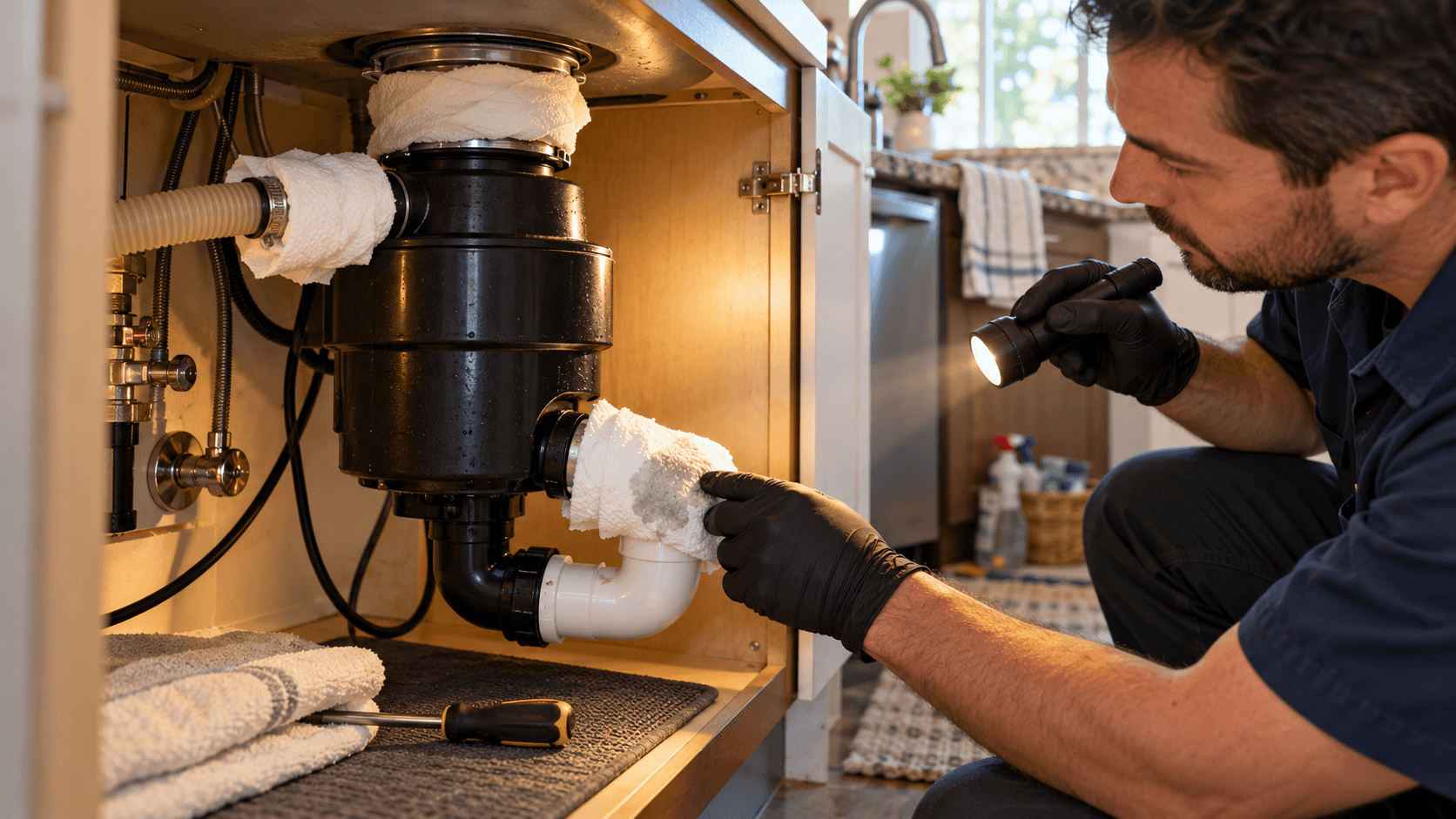
- Wrap paper towels around the sink flange, the dishwasher hose connection, and the drain elbow.
- Pull the stopper and watch with the flashlight as the sink drains.
- Check the towels. A wet one names the leak. If all three stay dry and water still beads on the underside or at the reset button, the leak is inside the unit.
One trap: Moen also notes that a damaged drain elbow gasket can send water between the outer shell and the disposal body, so it comes out at the bottom cover plate. If the elbow towel is even slightly damp, fix that joint and retest before you condemn the unit.
How to fix a leaking garbage disposal by leak point
Three of the four leaks are connection problems, and those are repairable. Leaks are among the common problems our garbage disposal repair service handles, along with jams, humming motors, and units that won’t turn on.
Leaking from the top at the sink flange
Plumber’s putty seals the flange to the sink, and the disposal hangs on a mounting ring beneath it. Putty dries out, and a bumped unit can twist loose. Tightening the ring sometimes stops the drip. If it doesn’t, the disposal has to come down to re-seal the flange: a fair job for a confident DIYer, a short one for a technician.
Leaking from the side at the dishwasher hose or drain elbow
A screwdriver fixes most of these. Tighten the dishwasher hose clamp and the drain elbow bolts, then retest. Still dripping? The elbow gasket has hardened or the hose has split, and that part needs replacing. Seals and gaskets, mounting components, and drain connections are all on the parts list for our garbage disposal repair in Austin.
Leaking from the bottom of the housing or the reset button
This is the one with no repair. The seals that keep water out of the motor sit inside the sealed body of the disposal, and on most household units you can’t replace them. Sealant on the outside won’t hold, and it leaves water sitting against live wiring. Replace the unit.
When to repair and when to replace a leaking disposal
The rule is short. Repair a leak at a connection. Replace the disposal when water comes through the housing, at any age, or when an old unit leaks and shows rust. InterNACHI’s standard life expectancy chart puts a food waste disposal at 12 years, so an 11-year-old unit with a weeping flange and a rust stain down its side isn’t worth a repair bill.
A new disposal needs a sealed flange, a secure mount, and tested plumbing and electrical connections, which is what our garbage disposal installation service covers. On a repair, a ProStar technician shows you where the water is coming from, gives you the estimate before work starts, and uses original manufacturer parts.
Either way, don’t wait. The EPA’s mold and moisture guide for homeowners says wet materials dried within 24 to 48 hours usually won’t grow mold. A cabinet floor under a slow drip never gets that chance.
Frequently asked questions about garbage disposal leaks
Can you fix a garbage disposal leaking from the bottom?
Not if the water is coming through the housing or the reset button. That means the internal seals have failed, and on most household disposals those seals aren’t replaceable, so the fix is a new unit. If water only collects at the bottom after running down from a loose connection, a technician can repair that connection.
Run the paper towel test above to tell the two apart.
How long should a garbage disposal last?
A garbage disposal should last about 12 years, based on the life expectancy figure home inspectors use for food waste disposals. Heavy daily use shortens that. A unit near or past that age that starts leaking, humming, or jamming is usually better replaced than repaired, because a repair on a worn-out disposal buys very little time.
How much does it cost to fix a leaking garbage disposal in San Antonio or Austin?
The cost depends on where the leak is. Tightening or re-sealing a connection is mostly labor, while a leak through the housing means paying for a new disposal plus installation. ProStar’s published minimum labor charge is $185, and the technician gives you an estimate on site before any work begins.
ProStar applies the service call fee toward the repair cost when you go ahead.
Is it safe to use a garbage disposal that is leaking?
No. A disposal that leaks through its housing has water sitting next to the motor and wiring, so switch it off at the breaker and leave it off. Put a bowl under the drip, stop running the dishwasher if it drains through the disposal, and keep the cabinet floor dry until the leak is fixed.
Get a leaking garbage disposal fixed in San Antonio or Austin
It comes down to one test. A wet towel at a connection means a repair. Dry connections and a dripping bottom mean a replacement, and running the unit in the meantime only adds a cabinet to the bill.
ProStar takes appointments 6 AM to 10 PM, every day, at our San Antonio location and our Round Rock location serving greater Austin, with roughly 2,000 Google reviews at a 4.93 average behind the work. Book now online at any hour, or call (210) 941-4634. A technician will find the leak, show you the cause, and back the repair for 90 days on parts and labor.

